The problem with manual scheduling
Most project scheduling is done by hand. A project manager opens a spreadsheet or Gantt tool, drags task bars around, and tries to keep everything consistent in their head. Who's available on Thursday? Can QA start before the backend code review is done? What happens if the frontend dev is sick for a day?
This approach breaks down quickly once you have parallel workstreams, shared resources, and real deadlines. You end up with a schedule that looks good on paper but falls apart on contact with reality.
How Bayes.ai solves it
Bayes.ai is project scheduling software built on a constraint solver. Instead of manually placing tasks on a timeline, you describe the constraints—task dependencies, people's skills and availability, effort estimates—and the solver computes a feasible schedule automatically.
- Automatic resource assignment — the scheduler matches people to tasks based on required skills and availability, resolving conflicts without manual intervention.
- Parallel track detection — independent workstreams are scheduled concurrently. Convergence points (like integration testing) wait for all upstream tracks to finish.
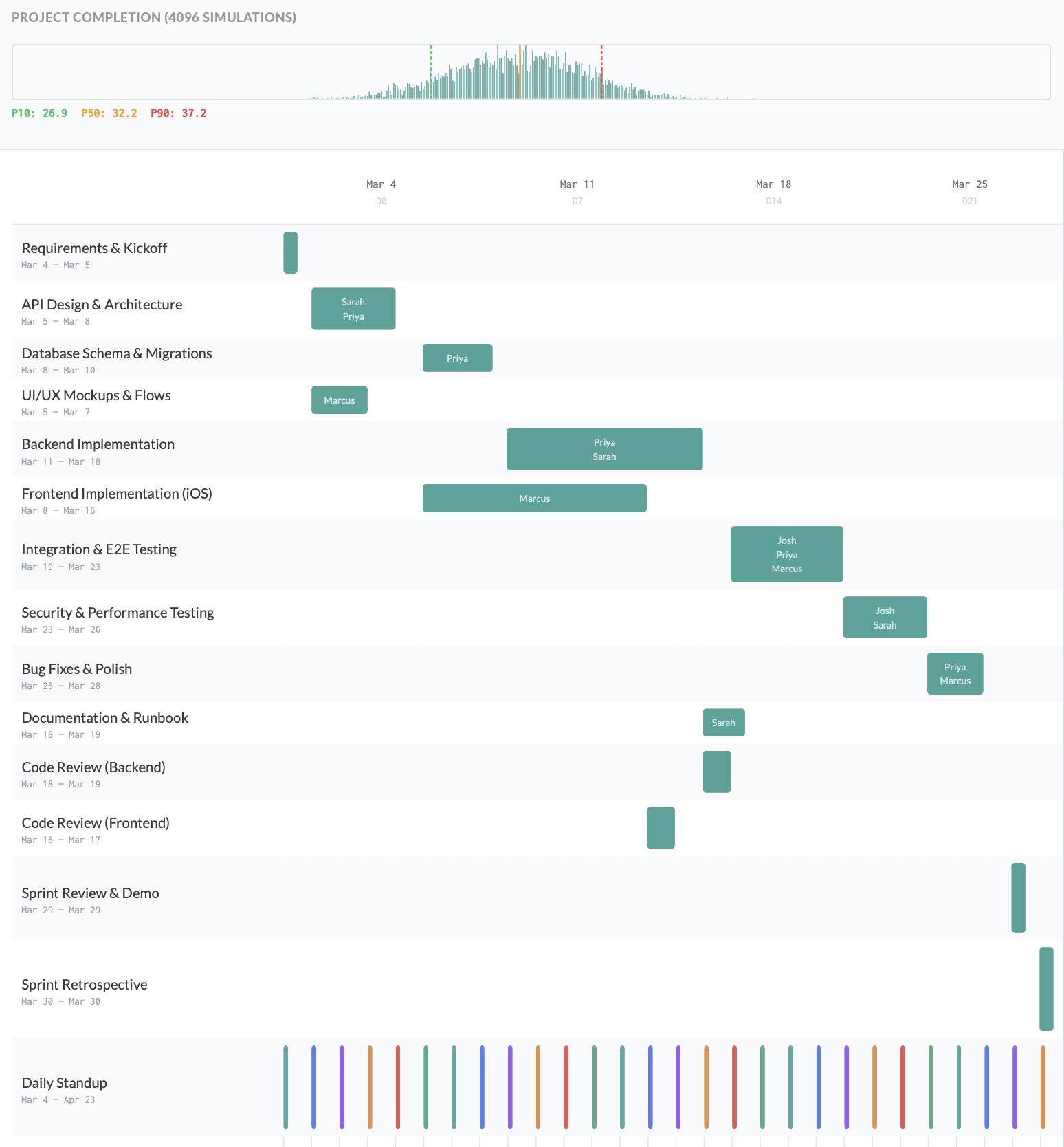
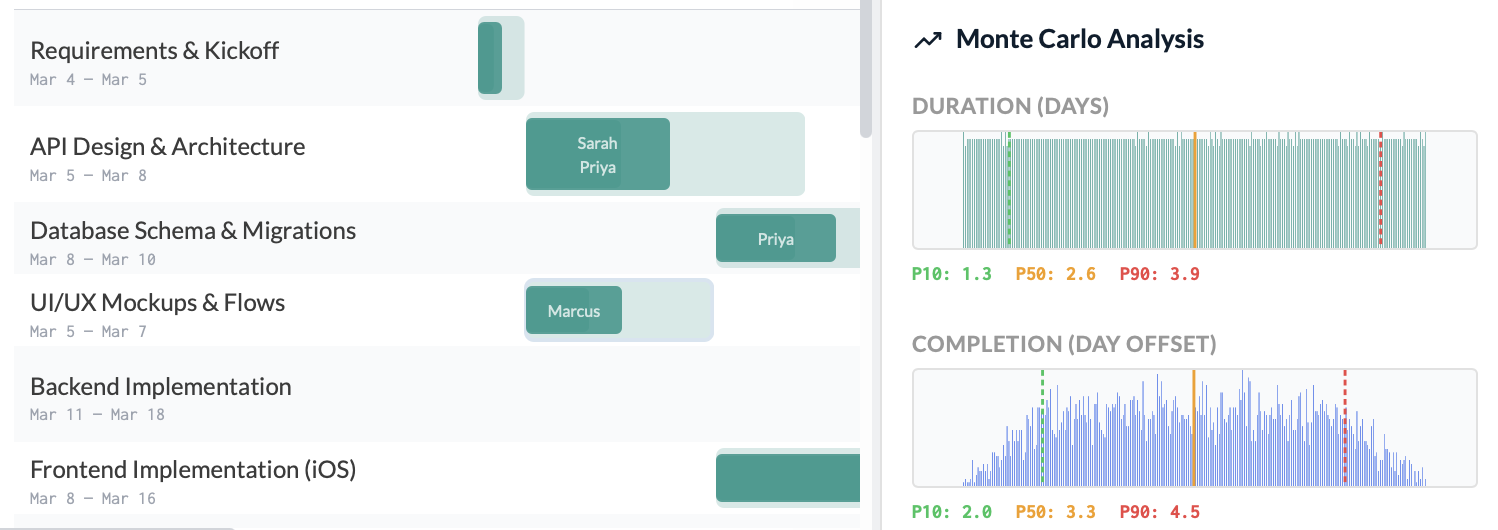
- Monte Carlo simulation — after solving, thousands of probabilistic simulations run to produce P10, P50, and P90 completion dates, giving you a realistic range instead of a single point estimate.
- Bayesian risk learning — record actual durations as tasks complete. Risk profiles update automatically, so future schedule estimates reflect real team performance.
Example: a 2-week software sprint
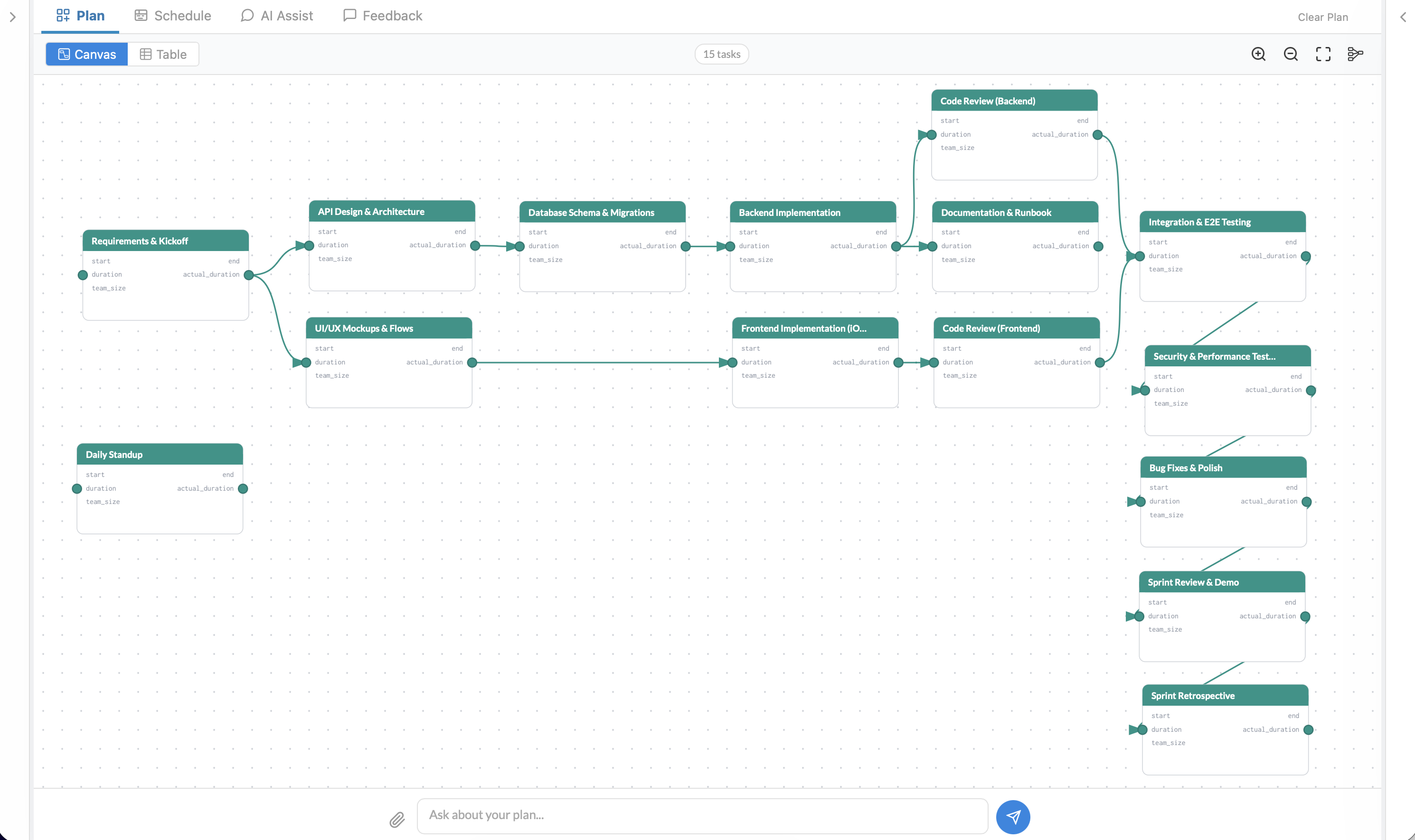
A fintech team of five—a tech lead, frontend developer, backend developer, QA engineer, and product manager—is building a peer-to-peer payment feature. The plan has 15 tasks across two parallel tracks:
- Backend track: API Design → Database Schema → Backend Implementation → Code Review
- Frontend track: UI/UX Mockups → iOS Implementation → Code Review
Both tracks converge at Integration Testing, followed by Security Testing, Bug Fixes, and Sprint Review. A recurring daily standup runs throughout.
Bayes.ai assigns each person to tasks matching their skills, schedules the two tracks in parallel, and computes that the sprint will take 14–18 working days with a P50 of 16 days. The PM sees exactly where contention exists—for instance, if Josh (QA) is the bottleneck during the testing phase.
What you get that spreadsheets can't give you
Conflict-free schedules. The solver guarantees that no person is double-booked. If your backend developer is needed for both the database schema and a code review, the solver sequences them correctly.
Probability ranges, not false precision. Traditional Gantt charts show a single end date with no uncertainty. Monte Carlo simulation gives you the 10th, 50th, and 90th percentile outcomes—so you can plan for the likely case and prepare for the worst.
Scenario comparison. Need to evaluate adding a sixth developer? Change the team and re-solve. The constraint solver recomputes the schedule in seconds, letting you compare options quantitatively.
Who uses it
Bayes.ai is used by engineering managers scheduling software sprints, construction contractors sequencing trades, and operations leads planning team rotations. Any project with people, tasks, and dependencies benefits from constraint-based scheduling over manual Gantt wrangling.