Why construction projects run late
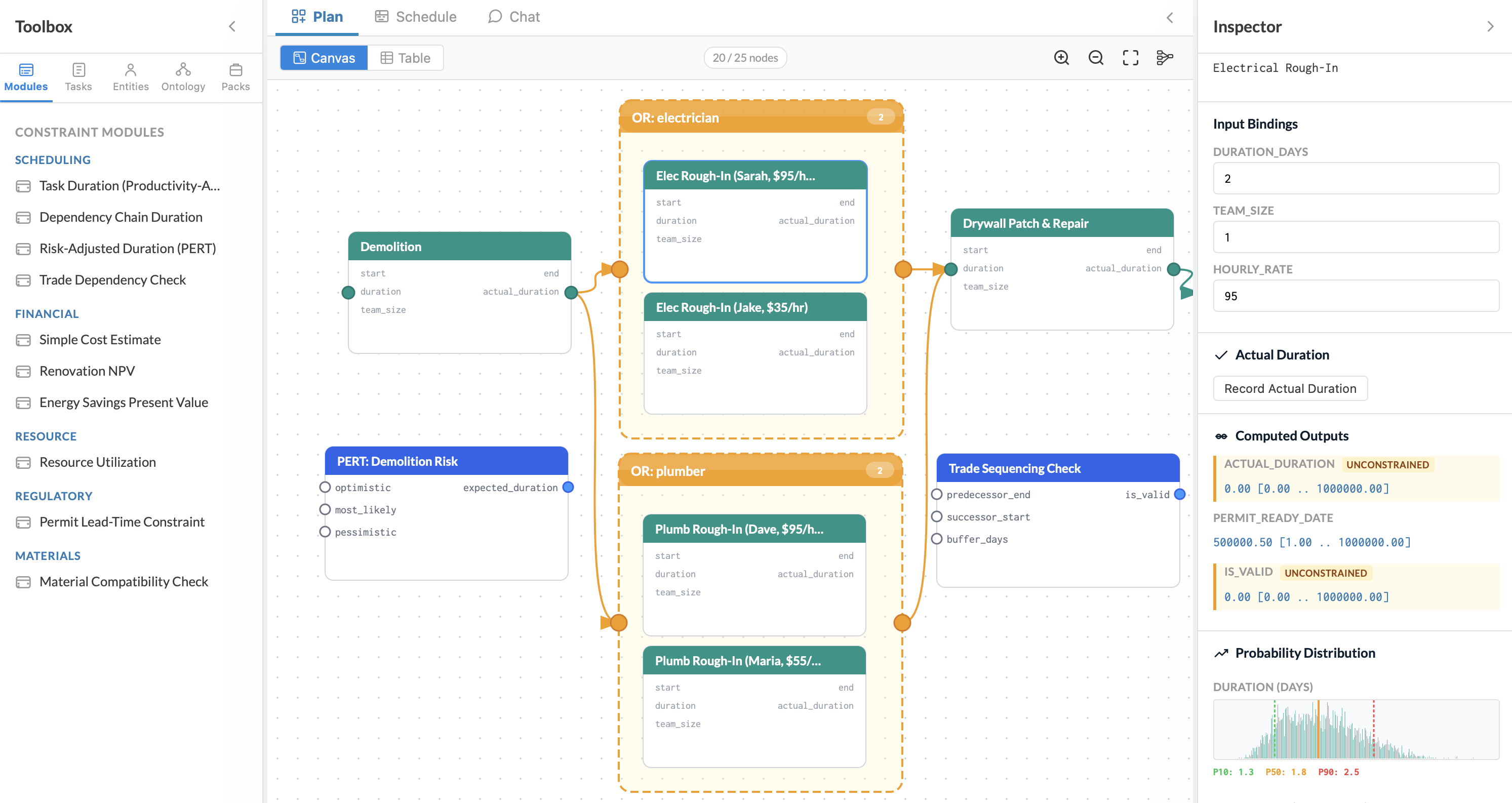
Construction scheduling is hard because everything depends on everything else. You can't install cabinets before drywall is patched. You can't patch drywall until the electrician and plumber finish rough-in. And every contractor has different availability, rates, and reliability.
Most homeowners and GCs manage this with a mental model or a basic spreadsheet. The result is a schedule that assumes everything goes perfectly—which it never does. One delayed trade cascades through the entire timeline.
Automatic trade sequencing
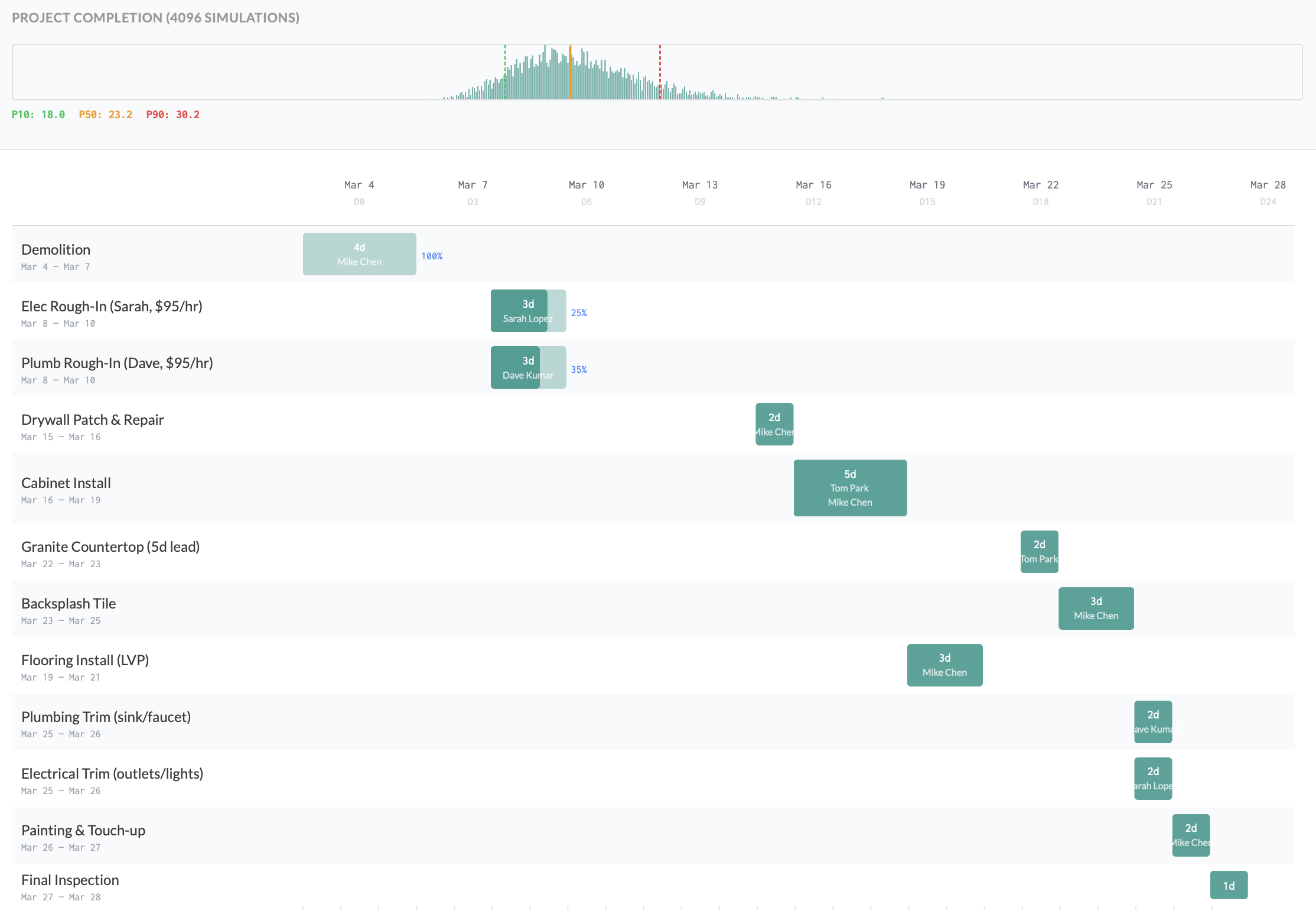
Bayes.ai uses a constraint solver to schedule construction projects. You define the tasks (demolition, rough-in, drywall, cabinets, countertops, flooring, trim, painting, inspection) and their dependencies. The solver computes the correct order and timing automatically, accounting for each person's real availability.
No dragging Gantt bars. No double-checking calendars. The solver handles sequencing, and if you change a task or dependency, it recomputes the entire schedule in seconds.
Compare contractors side by side
Real renovation decisions involve choosing between competing bids. Should you hire the experienced electrician at $95/hour who finishes in 2 days, or the apprentice at $35/hour who needs 4 days and is less predictable?
Bayes.ai models these alternatives as OR groups. You define both options, and the solver evaluates every combination to show you the cost, duration, and risk tradeoff for each scenario.
Example: Kitchen renovation with 8 scenarios
Mike is renovating his kitchen. He has three decisions to make:
| Decision | Option A | Option B |
|---|---|---|
| Electrician | Sarah Lopez — $95/hr, 2 days, very reliable | Jake Torres — $35/hr, 4 days, less predictable |
| Plumber | Dave Kumar — $95/hr, 2 days, tends to run over | Maria Santos — $55/hr, 3 days, very reliable |
| Countertop | Granite — $3,500, 5-day lead, 1-day install | Laminate — $700, 14-day lead, 2-day install |
That's 2 × 2 × 2 = 8 possible scenarios. Bayes.ai solves all eight and presents them as side-by-side comparison tiles with cost, duration, and risk scores. Mike can see that choosing Sarah (fast electrician) + Maria (reliable plumber) + Laminate (cheap countertop) gives the lowest cost, while Sarah + Dave + Granite gives the fastest completion.
Monte Carlo simulation for realistic timelines
Each contractor has a risk profile—a statistical model of how much they tend to run over or under. Sarah's risk bias of 0.85 means she typically finishes 15% early. Jake's bias of 1.4 means he averages 40% over estimate.
After solving the constraint schedule, Bayes.ai runs thousands of Monte Carlo simulations using these risk profiles. The result is a probability distribution for your project completion date: a P10 (optimistic), P50 (most likely), and P90 (conservative) estimate.
As work progresses and you record actual durations, the risk profiles update via Bayesian learning. Your schedule estimates get more accurate over the life of the project.
Who uses it for construction
Homeowners planning renovations who want to evaluate contractor bids quantitatively. General contractors scheduling multiple trades across overlapping jobs. Property managers coordinating maintenance and tenant improvements with limited contractor pools.
If your project involves sequencing dependent trades and choosing between alternative approaches, Bayes.ai replaces guesswork with computed schedules.